
The Leadership Capability Gap
July 4, 2026 2026-07-04 2:35The Leadership Capability Gap
The Leadership Capability Gap
Why two companies with the same AI will get very different results
Give two companies the same models, the same platforms, the same budget, and the same eighteen months. One pulls away. The other produces more dashboards, more pilots, and more decisions piling up on the CEO’s desk. Same technology. Different outcomes.
The difference isn’t the AI. It’s the organization’s capacity to use it. And that capacity was set long before the first tool was deployed.
AI isn’t creating a leadership capability gap. It’s exposing one that was already there.
For more than a century, organizations competed by accumulating knowledge. That advantage is dissolving. AI can analyze markets, synthesize research, generate strategy, and increasingly execute complex, multi-step work. Intelligence is becoming abundant, and abundant things stop being differentiators. What stays scarce is the judgment to decide what deserves action and the organizational capability to act on it.
AI is democratizing intelligence. It is not democratizing judgment.
Judgment is deciding what deserves action, what should remain human, and what must change.
Leadership capability is no longer just the quality of individual leaders. It is an organization’s capacity to redesign work, distribute sound judgment, spread learning, and continually adapt as technology evolves. It is an organizational operating capability. It shapes how decisions are made, how work is redesigned, how judgment is distributed, how learning spreads, and how quickly the enterprise adapts.
That’s why leadership capability, not AI, determines whether all this intelligence becomes a competitive advantage or an expensive disappointment.
The gap
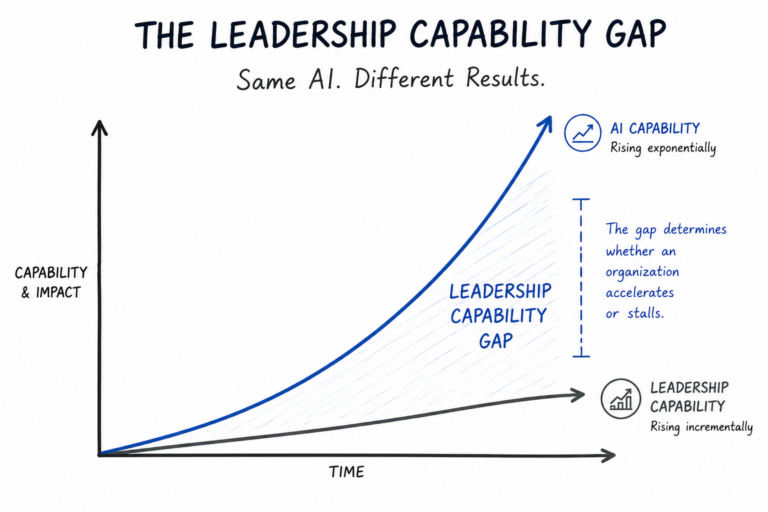
Picture two curves. AI capability is rising exponentially: faster models, cheaper analysis, and more autonomous execution every quarter. Leadership capability rises incrementally, built organization by organization through redesigned work, better decisions, and repeated practice.
The distance between those curves is the Leadership Capability Gap. It determines whether an organization accelerates or stalls.
It helps to think of the relationship less as a sum than as a product. Powerful AI multiplied by weak leadership still produces a weak result because the second factor limits the first. Most AI transformations won’t fail because the technology isn’t good enough. They’ll fail because leadership capability doesn’t evolve fast enough to absorb it.
The evidence is already visible. A widely cited 2025 MIT study found that 95% of enterprise generative AI pilots delivered no measurable impact on the P&L. That headline is debated, but larger research points in the same direction. McKinsey’s 2025 survey of roughly 2,000 organizations across 105 countries found that only about 6% are capturing significant value from AI. Of the twenty-five factors it tested, the strongest predictor of financial impact wasn’t the technology. It was whether organizations redesigned how work actually gets done.
The tools are becoming available to everyone, but the capability to use them well is not.
Here’s the uncomfortable reality. The organizations most at risk aren’t the AI laggards. They’re the eager adopters, the ones with the most licenses, the most pilots, and the most impressive dashboards, because adoption increased while organizational capability didn’t.
By now, most organizations know what responsible AI deployment looks like. They have governance, enterprise tools, pilot programs, training, and adoption dashboards. Those things matter. They reduce risk, create access, and help people begin using AI effectively.
Today they’re table stakes.
The standard AI playbook creates access. Leadership capability turns access into advantage.
Yet investment rarely reflects this. Organizations spend millions on AI platforms while investing comparatively little in the leadership capability required to realize their value.
Technology can be purchased.
The capacity to use it well cannot.
That imbalance is becoming one of the most expensive strategic mistakes of the decade.
The CEO amplification challenge
The gap stays hidden until AI makes it visible, and it surfaces first at the top.
Many senior leaders assume AI will lighten their load. The opposite happens.
Better analysis produces more options.
More options produce more decisions.
Without a corresponding increase in leadership capability across the executive team, those decisions flow upward. The CEO becomes the destination for more decisions, not fewer. AI doesn’t automatically remove bottlenecks. It exposes them.
When an executive team develops the judgment and confidence to lead alongside AI, the pattern reverses. Decisions move closer to the work. The CEO shifts from chief problem solver to enterprise amplifier.
That capability isn’t built by attending another AI presentation. It’s built by redesigning work.
One executive team spent a day not learning about AI but building with it. Every executive created a working AI agent around their own responsibilities. What changed wasn’t simply their command of the tools. They began asking different questions about their organizations.
What should no longer require executive approval?
What work should disappear entirely?
What decisions belong closer to the customer?
Capability spread because leaders worked differently together, not because they attended another training session.
Closing the gap
Closing the gap is not a technology project. It’s the work of changing how an organization thinks, decides, and collaborates.
The organizations closing the gap aren’t waiting for another platform rollout. They’re redesigning work, pushing decisions closer to where the work happens, spreading what works across teams, and adapting their operating model faster than competitors.
Executives build their own agents. Managers redesign workflows instead of simply automating old ones. Teams create tools for problems they once escalated. Learning spreads across functions instead of remaining inside isolated pilots.
Each one strengthens the same organizational capability: knowing where AI belongs and having the confidence to redesign work around it.
Which is why the right thing to measure changes.
Most organizations measure AI success through adoption: logins, licenses, seats, and use cases.
The organizations pulling ahead measure capability instead.
Are leaders redesigning work?
Are decisions moving closer to where the work happens?
Are managers delegating differently?
Is learning spreading across functions?
Those measures tell you whether leadership capability is actually growing.
Access creates experimentation.
Capability creates competitive advantage.
It also changes what leadership looks like.
When expertise is abundant, leadership is no longer defined by having the best answers. It is defined by designing an organization that consistently finds better answers. That means deciding which decisions stay fully human, which should be augmented by AI, and which can be delegated to intelligent systems, then revisiting those boundaries as the organization learns.
As AI drives down the cost of intelligence, it raises the value of judgment. As execution accelerates, the cost of poor judgment rises because organizations now act on decisions faster than ever.
Judgment becomes governance.
In regulated, high-stakes, or ethically complex work, some decisions should remain human by design. Knowing where those boundaries belong, and revisiting them as technology advances, is itself a leadership capability.
The only scarce resource
It’s tempting to copy what the companies pulling ahead are doing. Require AI use. Launch an AI academy. Stand up a governance council. Build internal agents. Each may be worthwhile, but none of them is the strategy.
They’re expressions of a deeper capability. Without that capability, they become another initiative instead of changing how the organization operates.
Every competitor will eventually buy similar models, platforms, and agents.
Technology will become commonplace.
Intelligence will become abundant.
Leadership capability will not.
The organizations that pull ahead won’t simply adopt AI faster. They’ll redesign work faster, distribute better judgment faster, spread what they learn more quickly, and adapt faster because AI doesn’t create enterprise transformation.
Leadership capability does.
So don’t copy the practices.
Build the capability.
In the age of abundant intelligence, the scarcest resource isn’t technology. It’s the organizational capability to turn intelligence into enduring competitive advantage.
If This Feels Familiar
If you recognized your own organization in this, the waiting, the hesitation, the sense that everyone is looking around for someone else to move first, that pattern rarely resolves on its own. It changes when leaders learn how to operate before certainty arrives. That’s the work we do.
If you’d like to talk through where your organization might be stuck and what the first move could look like, we’d be glad to compare notes.
If you’re also navigating execution drag, you may want to read:: How Leaders Can Build Teams in a World of Uncertainty